

On January 5th, Beau Bayh accepted a $25,000 donation from his father’s boss, Apollo Global Management CEO Marc Rowan—and ignited a debate on the left about the ethics of taking money from MAGA billionaires.
The centrist argument is simple: “It takes money and name recognition to win, and Beau Bayh has both.”
Let’s pause on that logic.
We are supposed to take money from a MAGA financier…to elect Democrats who will stop…the MAGA movement?

The financier in question, Marc Rowan, is a billionaire, AIPAC mega-donor, who gave $1 million to the Trump Victory super PAC in 2020 and was once in the running to be Trump’s Treasury Secretary.
Still think having Marc Rowan on the donor sheet is nothing to worry about?
Grab your coffee or your Dr. Pepper and let’s take a closer look.
Who is Marc Rowan? Let’s Connect the Dots.
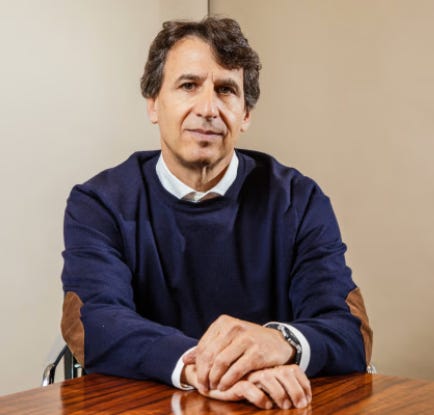
Marc Rowan, the Apollo CEO who just donated $25,000 to Beau Bayh, isn’t just any billionaire.
His career is a masterclass in using wealth and power to bend rules, institutions, and politics to his will.
First, the Personal Power Play
In the 2010s, Rowan fought Montauk residents to build a waterfront restaurant. When he couldn’t win community favor, he sued the town nine times until he prevailed—a clear example of using financial might to override local opposition. Because this is Marc Rowan’s modus operandi: overcome obstacles not through persuasion, but through sheer financial and legal force.
Then, the Political Machine
Rowan is a Republican mega-donor. He gave $1 million to Trump in 2020 and was considered for Treasury Secretary. Now, he’s a key architect of Trump’s higher education agenda, drafting a “compact” that would force universities to ban affirmative action, limit protests, and reject transgender identity to receive federal funds.
In 2018, Marc Rowan gave UPenn a record $50 million, cementing his influence.
That influence was cashed in during the crisis over the 2023 Palestine Writes Literature Festival. As a powerful trustee, Rowan signed an open letter demanding President Liz Magill take a harder line against the event.
The conflict moved to the national stage during the December 2023 congressional hearing on campus antisemitism. In a pivotal exchange, Rep. Elise Stefanik (R-N.Y.) grilled Magill on whether calls for genocide violated Penn’s conduct policies—a line of questioning that sparked intense controversy. It is critical to note that Stefanik, along with hearing chair Rep. Virginia Foxx (R-N.C.) and participant Rep. Jim Banks (R-Ind.), were all political beneficiaries of Rowan’s donations. The hearing provided the public catalyst. Rowan then applied the final, private pressure. In 2024, he openly called for Magill’s resignation and orchestrated a concerted donor revolt. The result was inevitable–Liz Magill resigned.
The pattern is clear. Rowan’s money funds the politicians who create the public pressure, which he then amplifies with private financial threats to achieve his desired institutional change.
The Apollo-Bayh Connection is the Point.
This brings us to Beau Bayh and his father, former Senator Evan Bayh.
In 2010, as a Senator, Evan Bayh cast the key vote to preserve the “carried interest” tax loophole—a massive financial benefit for private equity firms like Apollo. Evan Bayh’s relationship with the firm was already cozy. That same fall, he met multiple times with Apollo’s then-CEO, Leon Black, because he felt it was important to meet with people who would be policed by new financial regulations. Weeks after Evan Bayh left the Senate, Apollo hired him as a Senior Adviser.
It’s also worth noting that Adam Aron is an Apollo executive who donated $10,000 to Evan’s son, Beau Bayh, in early October of 2025. Now, Apollo’s CEO is funding Evan’s son’s campaign, while other Apollo executives and connected donors (like RLJ’s Robert Johnson) pour money into Beau’s coffers.
This isn’t a coincidence.
It’s the cycle of influence…a political favor is repaid with a lucrative job, which is then cemented with campaign donations to the next generation.
Evan Bayh’s post-Senate career maps perfectly onto this playbook. His reward for the carried interest vote was a lucrative position as a Senior Advisor at Apollo, which came with a seat on the board of Marathon Petroleum. Furthermore, his Apollo role integrated him into its wider financial network. He now chairs a governance committee for RLJ Lodging Trust, founded by Robert L. Johnson—who is also a $300,000 donor to Beau.
The connections compound: David Simon, a member of Apollo’s own board, is the nephew of Herbert Simon, another top-tier donor to Beau’s campaign. The flow of influence, jobs, and donations forms a closed circuit.
What is Rowan Buying?
Look at Apollo’s recent moves juxtaposed Trump’s plans:
Data Center Empire: Apollo has built a commanding position in this critical sector. It now controls a major U.S. data center company and, in January 2026, provided $3.5 billion to finance a $5.4 billion deal for advanced AI chips. This technology is being leased to Elon Musk’s xAI to build a top-tier supercomputer to train its chatbot, Grok.
Trump’s Gaza Plan: The ultimate return on Rowan’s political investment came post-election. Trump appointed him to the boards overseeing Gaza’s long-term stabilization–a so-called “Board of Peace” that has been criticized for excluding Palestinian voices. Trump’s “Master Plan,” is a vision of sweeping commercial redevelopment: 170 residential towers, coastal tourism, and, crucially, industrial zones for data centers and advanced manufacturing.
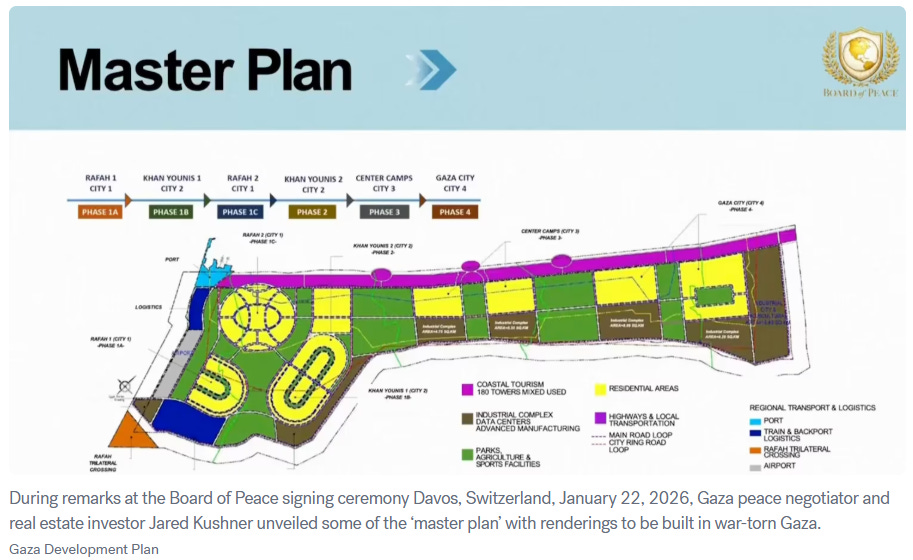
The connection is stark. A man whose firm finances AI data centers is now helping draft a plan to build them on blood-soaked soil.
Think about that for a moment, dear reader.
A CEO whose company invests in restaurants, hotels, real estate, and infrastructure is shaping a blueprint that perfectly aligns with Apollo’s investment portfolio.
This isn’t just influence.
It’s the merger of geopolitical strategy and corporate business development.
And for us Hoosiers, it unfolds against a telling backdrop as Indiana, the state Beau Bayh aims to represent, is in the midst of its own data center boom, with over 30 centers proposed.
The Final Picture:
Marc Rowan isn’t just donating to a Democrat. He is investing in influence and access that will ultimately protect his wealth (tax loopholes), shape policy (campus rules, Gaza reconstruction), and secure future markets (data centers in Indiana and abroad) for Apollo Global Management.
And the $25,000 to Beau Bayh’s campaign is a small price to pay to keep this cycle of power turning.
The question isn’t if Beau Bayh has name recognition—it’s whose recognition, and what they expect in return.
And this system isn’t illegal. It’s the way power often works in America.
So as usual Hoosiers, we find ourselves at a crossroads.
Do we accept the billionaire’s funding?
Or do we take the road less traveled and back the grassroots candidate?
Are we electing representatives, or are we installing middlemen for private equity dealmaking?
The answer, dear reader, will make all the difference.
Nailed it, Lemon! Every last bit of this.
Also, I will never sour on the lemon puns.