

Grief is the most common human experience. Every single one of us will lose people we love. Yet the United States treats grief like a personal inconvenience rather than a public reality. That isn’t an accident. It’s the result of political choices—decisions made over decades about labor laws, worker protections, and whose suffering “counts.”
And right now, the system is failing grieving people.
The Politics of Grief: How We Got Here
The U.S. has no federal requirement for paid bereavement leave. None.
Whether you get time to grieve depends entirely on your employer, your job classification, and your state. That’s not a cultural quirk—it’s a policy vacuum.
Here’s what the research shows:
The U.S. is one of the only wealthy nations with no national bereavement leave standard.
Only 1 in 5 employers offer more than 5 days of leave for the death of an immediate family member.
Independent contractors—like the 1099 role you held—receive zero guaranteed protections.
The federal government’s 2023 Report to Congress on Bereavement explicitly states that grief is a long-term process and that lack of support worsens mental health outcomes.
These conditions didn’t appear out of nowhere. They reflect decades of political decisions prioritizing corporate flexibility over human well-being.
Grief Isn’t Just Personal—It’s Structural
When you lost your husband to COVID‑19 and had no bereavement leave, that wasn’t a personal tragedy alone. It was also a policy failure.
During the pandemic, more than 200,000 children lost a parent or caregiver. Millions of adults lost spouses, siblings, and parents. Yet the U.S. still did not expand bereavement protections, even temporarily, despite clear evidence that:
Grief impairs cognitive functioning
Traumatic loss increases risk of Prolonged Grief Disorder
Workers experiencing grief have higher rates of absenteeism, errors, and burnout
Supportive leave policies improve long-term health and economic stability
Ignoring grief isn’t just cruel—it’s expensive. Employers lose billions annually due to unaddressed grief in the workplace. But because bereavement leave isn’t mandated, companies have no incentive to change.
That’s what political choices look like in real life.
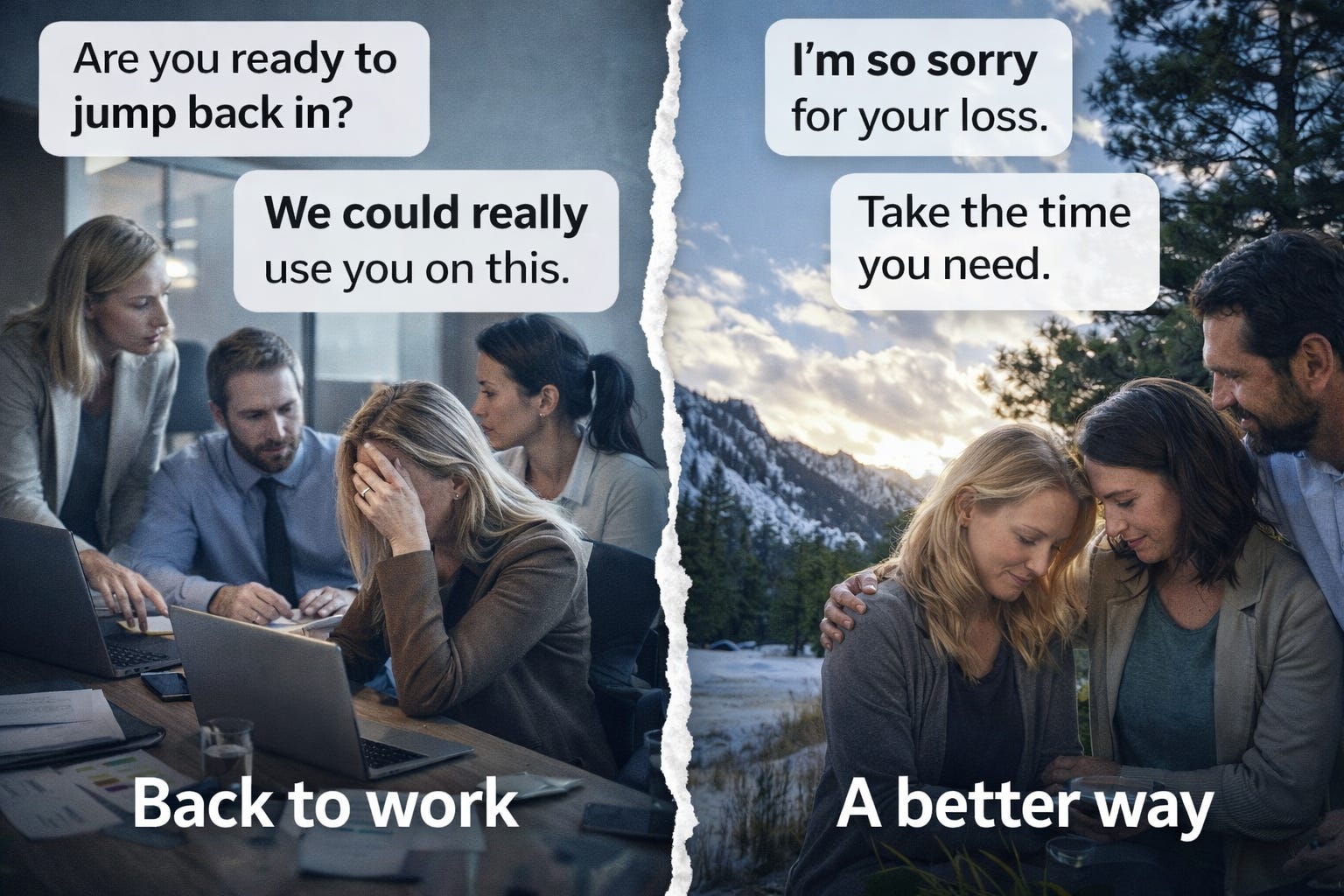
The Myth of “Three Days” Is a Political Myth
The idea that three days is “enough” didn’t come from psychologists, trauma experts, or grief researchers. It came from corporate norms that became embedded in HR policy and never updated.
Experts estimate that healthy grieving after a major loss takes 18–24 months.
Not three days. Not three weeks. Not even three months.
But because we don’t talk about grief—and because our laws don’t acknowledge it—people assume the problem is them, not the system.
Why This Matters Politically
Grief is not partisan. But the policies that shape how we grieve absolutely are.
When lawmakers choose not to mandate bereavement leave, that is a political decision.
When states classify more workers as contractors without protections, that is a political decision.
When Congress receives a report urging national bereavement standards and does nothing, that is a political decision.
And those decisions shape the most vulnerable moments of people’s lives.
This is why civic participation matters. Not because politics is fun or because elections are entertainment, but because the laws we live under determine whether we are treated as workers first and humans second—or the other way around.
I urge you to look at campaign finance reports. When you follow the money, patterns become impossible to ignore. Many elected officials receive significant funding from large corporations, industry groups, and wealthy donors. From my perspective, this creates a system where the same political elites are repeatedly elected and then continue to vote in ways that benefit corporations and billionaires over ordinary people. If we want to see meaningful change—policies that support workers, families, and people who are grieving—we have to stop sending the same individuals back into office who are financially incentivized to maintain the status quo.
Always verify campaign finance information through trusted, nonpartisan sources such as the Federal Election Commission (FEC.gov) or OpenSecrets.org.
Grief Is Human. Our Policies Should Be Too.
We’ve normalized a culture where breaking down at work is seen as a weakness, where grieving for more than a few weeks is treated as a problem, and where people are expected to crowdfund time to mourn their spouse.
That isn’t a cultural failure. It’s a policy failure.
If we want a society that treats grief with dignity, we need laws that reflect the reality of human experience—not the demands of corporate productivity.
This is the first article in a series about how politics shapes your life in ways you may not even realize.
Check your voter registration today, and make sure you’re ready to vote this November.
(Always confirm voting information with a trusted source such as vote.gov.)