

Between now and the Indiana state Democratic Party convention, Hoosier Lemon will be making the case that Beau Bayh is NOT the right person to represent the party as nominee for Secretary of State in 2026, nor should be the person to lead Indiana Democrats into the future. A pretty face and a fat bank account are no substitute for leadership — and Beau’s deep connections to the corporations, billionaires, and special interests that play both sides of the aisle should make the delegates who vote on this nomination think long and hard before casting their votes.
Check out last week’s piece on the school privatization champion dropping big money on Beau here.
Previously, we detailed Bayh’s ties to the Israel lobby right here.
And before that, we examined Beau’s relationship with the private equity industry here.
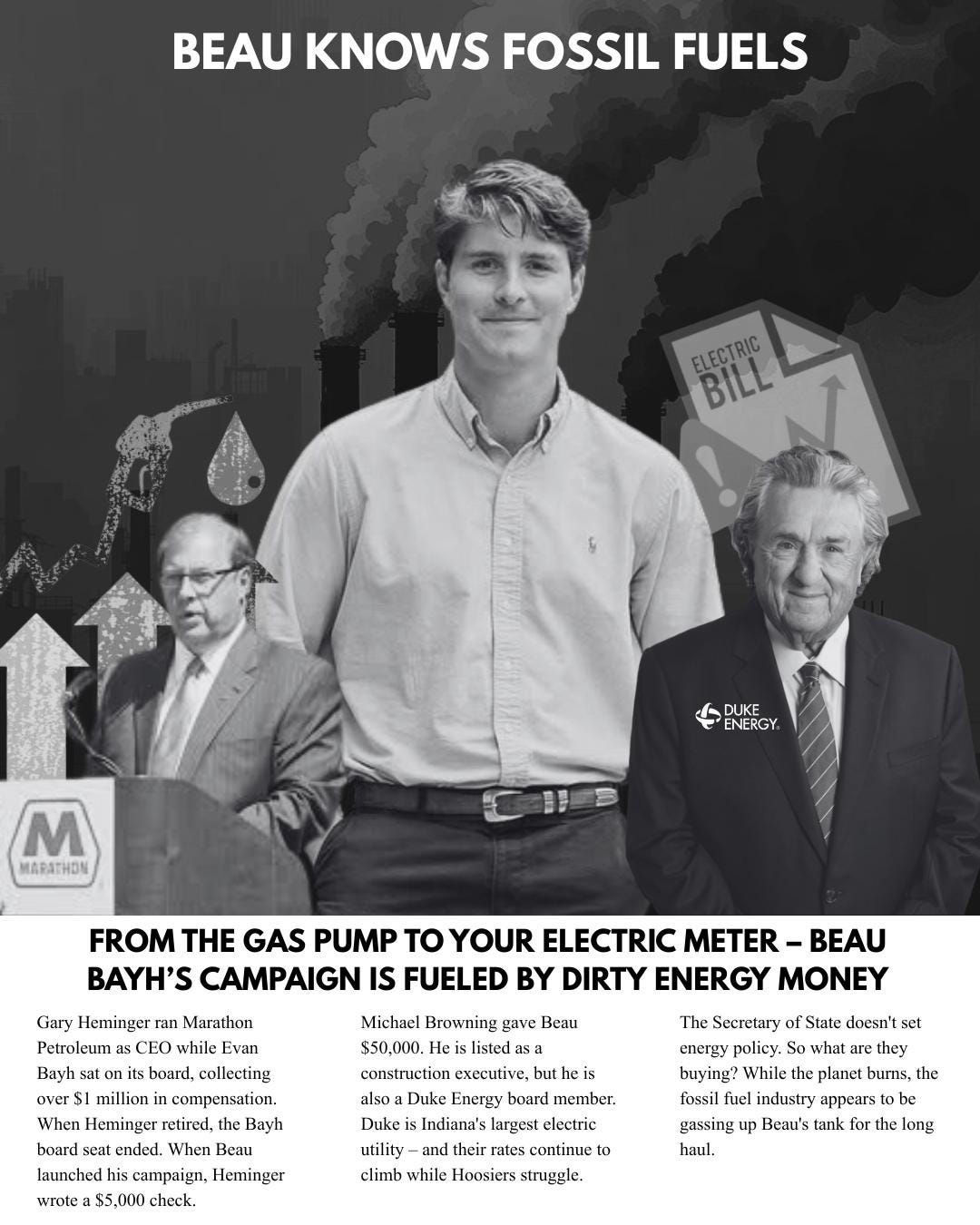
Hoosiers Don’t Need a Lecture. They Need to Follow the Money.
Hoosiers don’t need another reporter or politician to tell them the price of oil per barrel went up or that we’re in the midst of an energy crisis to feel the squeeze.
We feel it at the gas pump while paying $4.30 a gallon here in central Indiana and we feel it when we open the electric bill. And all the while, the fossil fuel industry is pouring money into a candidate for Indiana’s Secretary of State’s race.
It’s worth asking, dear reader, who is fueling Beau Bayh’s campaign? And why?
The Fossils Fueling the Bayh Campaign
First, let’s start with who is funding Beau Bayh. And I can certainly tell you it isn’t Joe Lunch Pail.
Let’s start with Gary Heminger, former CEO of Marathon Petroleum and recipient of the American Petroleum Institute’s Gold Medal for Distinguished Achievement—the institute’s highest honor.
And I know what some of you are thinking: he’s just a retired executive.
And yes, Heminger retired as CEO in 2020, however, retirement for a man of his means doesn’t mean what it means for the rest of us. This January, he sold his Findlay, Ohio mansion for $1.5 million to a fellow Marathon insider. So he’s not just a retired executive, he’s a man with a network of powerful and influential people and a net worth of $168 million. He’s a man who used to run the nation’s fourth-largest oil refiner, a company capable of processing 1.7 million barrels of crude a day, and who sat alongside Beau’s father, Evan, on Marathon’s Board of Directors. During Evan Bayh’s time on that board, he bagged millions in compensation—a nice haul for a man whose son now wants to regulate the industry that paid him.
Heminger’s $5,000 donation to Bayh might be roughly what the median Marathon worker makes in two weeks (before taxes, of course) but is by no means the biggest one on the books.
Michael Browning, a Duke Energy board member, gave Beau Bayh $50,000.
Duke Energy is Indiana’s largest investor-owned electric utility, thus Hoosiers have good reason to wonder why a Duke board member is pouring money into a candidate who could oversee securities investigations. Because Duke has a habit of making Hoosiers pay for its mistakes.
In 2020, the Environmental Working Group accused Duke of charging Indiana ratepayers for $12 billion in failed projects. Think about that for a second. Twelve B-I-L-L-I-O-N dollars. That includes two natural gas pipelines that never moved a single molecule of gas, two retired nuclear plants that no longer generate a watt, and the notorious Edwardsport plant boondoggle.
Duke’s share of those failures? Over $4.3 billion. And who paid? Not Duke’s shareholders. Not CEO Lynn Good’s bonus. We did. Every time we paid the electric bill.
Regulators in other states have let Duke stick ratepayers with another $2.6 billion for failed plants in Florida and the Carolinas. Meanwhile, Duke has fought against rooftop solar and community solar (the sort of energy independence that could soothe our pocketbooks) while funneling $50,000 to Bayh’s campaign.
So when you see Michael Browning’s name on Bayh’s donor list, don’t ask what Duke wants from the Secretary of State. Ask what Duke wants to keep from the Secretary of State. The answer is likely a studious pair of eyes watching their books.
So at a moment when Hoosiers are watching their rates climb while service doesn’t noticeably improve, it’s enough to make one wonder—why would the fossil fuel industry be interested in Beau Bayh?
Is it because they believe he will “save the Hoosier state” as some of his more rabid supporters have suggested? Of course not. But you, dear reader, are too smart to fall for the “great man of history” fallacy.
Why Does Big Oil Care?
Now here’s the part that doesn’t show up in campaign ads: one of the roles of the Secretary of State is to oversee securities filings, business registrations, and investigations into financial misconduct.
So for a company like Marathon Petroleum, which has a long history of legal and regulatory scrutiny, that office matters.
And this isn’t new. A 1982 FTC report warned that Marathon’s market power, left unchecked, could choke out independent competitors. Four decades later, the warning still fits.
Now consider the 2015 Kentucky lawsuit.
Then Attorney General Jack Conway sued Marathon for illegally monopolizing Kentucky’s wholesale gasoline market. The weapon of choice? Deed restrictions and supply agreements that locked out competitors. Marathon settled without admitting wrongdoing, because of course they did. But here’s the thing: a company that deploys aggressive legal tricks to control state markets has a very practical interest in who oversees securities filings and business registrations. In the Hoosier state, that’s the Secretary of State’s desk. The same desk Beau Bayh wants to park himself behind.
Marathon owns roughly seven terminals, several industrial plants, and a significant footprint across Indiana. Marathon’s pipeline financing arm, MPLX, relies on securities filings reviewed by (you guessed it) the Indiana Secretary of State’s office, which has “police powers” to investigate securities violations (Indiana Code §23-2-6). And the Secretary of State decides what counts as “public information” in investigations.
Fun fact, Gary Heminger ran Marathon’s pipeline company in the 1990s. Now his old employer’s pipeline financing arm files disclosures that cross the Secretary of State’s desk. Funny how that works.
For a company repeatedly under federal antitrust scrutiny, a friendly regulator in a key energy state is not incidental—it’s strategic.
A strategic investment in the regulator that oversees fossil fuel companies’ ability to raise capital in Indiana isn’t just a political donation. It’s an insurance policy. It’s the cost of doing business.
So What Are They Bayh-ing?
While the Secretary of State doesn’t set energy policy, the office does control the levers of financial disclosure and corporate oversight. Levers that companies like Marathon and Duke would very much like to remain friendly.
Beau Bayh claims to be about “restoring accountability and trust” to the office, but his campaign finance reports tell a different story.
Follow the money, dear reader. It leads straight from the gas pump to your electric meter and lands right in the pockets of his donors.
Hoosiers don’t need a lecture. They just need to follow the money.
It is in bad taste as well as destructive for Democrats/progressives to attack our own people. In this case, candidates for Secretary of State.
Here is a thought: Blythe has been campaigning hard for a number of months, and we appreciate and acknowledge that.
At the same time, if this post, and other posts you are putting on social media, are actually shills for the Potter campaign, shame on you. Does not reflect well. Be honest.
If you are campaigning for Blythe, do not attack Beau. You are shooting us progressives and Democrats in the foot. Big mistake – this can splinter our party, and we cannot afford that in our heavily gerrymandered state.
If you are campaigning for Blythe, be upfront, be decent, be honorable. Talk about her virtues, period.