


SUMMARY:
Scott convenes a five-person roundtable to unpack democratic socialism — what it means in political science terms and what it means to each of them personally. The panel: Debbie Asberry, co-founder of Hoosiers for Democracy and president of In Good Company Consulting; Bryce Greene, PhD student in informatics at IU, Graduate Workers Coalition organizer, and published writer; Blythe Potter, Army veteran, small business owner, and recent Indiana Democratic Party Secretary of State candidate; and Indianapolis City-County Councilor Jesse Brown, the first openly elected socialist in Indiana in over a century. Starting from a viral chart attempting to define socialism, communism, and capitalism, the conversation ranges across the actual history of “actually existing” communist and socialist projects, why so many popular American policies get branded as dangerous the moment the word socialism attaches to them, Truman’s famous 1952 takedown of the socialism smear, the real content of the national DSA platform, messaging strategy versus running from labels, and the perennial bind of being told simultaneously to stay inside the Democratic tent and to shut up once you’re there.
Progressive Indiana Network: https://progressiveindiana.net
HoosLeft: https://hoosleft.us
Deborah Asberry: https://www.hoosiers4democracy.org/
Bryce Greene: https://brycegreene.substack.com/
Blythe Potter: https://www.blythepotter.com/
Jesse Brown: https://www.jesseforindy.com/
WHAT’S INSIDE:
00:00:21 Introduction: Tonight’s Topic Is Democratic Socialism
- Scott frames the night’s agenda: defining democratic socialism in political science terms and personal terms, overcoming Red Scare branding, the national DSA platform, working within the Democratic Party versus building a standalone party, and how much focus should go to electoral politics versus social activism and community building.
00:01:07 Support the Show
- HoosLeft and Progressive Indiana Network don’t paywall content — support at progressiveindiana.net sustains the project. Social handles: @hoosleft.us on Bluesky, Instagram, and Threads; @HoosLeft on Facebook, TikTok, and YouTube; PIN is @pinindiana on Bluesky and TikTok.
00:02:04 Welcome: Debbie Asberry, Bryce Greene, Blythe Potter, and Jesse Brown
- Debbie Asberry: co-founder of Hoosiers for Democracy (a Substack newsletter and grassroots activist network) and president of In Good Company Consulting, working in organizational development, leadership development, and systems theory.
- Bryce Greene: PhD student in informatics at IU, organizer with the Graduate Workers Coalition, published in Fairness and Accuracy in Reporting, Salon, Monthly Review Online, and SharePost.
- Blythe Potter: U.S. Army veteran, small business owner with an MBA in Conscious Capitalism, recent candidate for the Indiana Democratic Party’s Secretary of State nomination.
- Jesse Brown: Indianapolis City-County Councilor and, per Scott’s introduction, the first elected open socialist in Indiana in over a hundred years.
00:04:52 The Democratic Socialism Chart: Setting Up Tonight’s Question
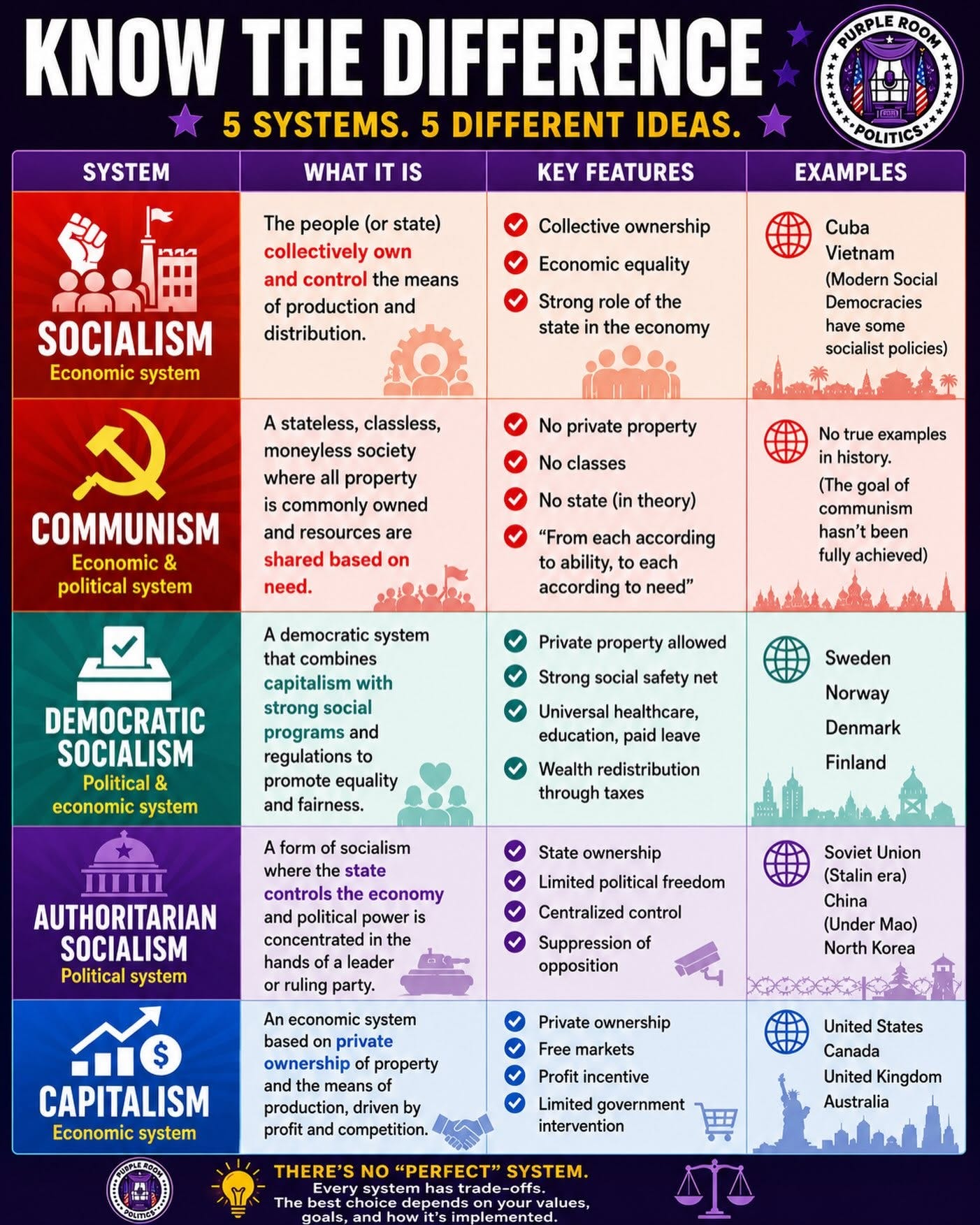
- Scott introduces a chart circulating online since this summer’s DSA-backed primary wins in New York, attempting to define socialism, democratic socialism, and capitalism side by side — better than some versions he’s seen, but still imperfect, and a useful jumping-off point for tonight.
00:06:15 Debbie’s 15-Hour Deep Dive Into the Terminology
- Debbie explains writing her own explainer article after the New York primary wins (candidates endorsed by Zohran Mamdani) made “Democratic Socialists of America” a suddenly unavoidable term she didn’t fully understand herself. A roughly 15-hour research dive into distinguishing state-owned socialism, social democracy, and socialism left her still finding the definitional lines genuinely blurry.
00:07:37 Jesse Breaks Down the Chart: Private Property vs. Personal Property
- Jesse credits the chart as better than most but explains the crucial distinction it gestures at: socialism opposes private property in the sense of capital that generates passive wealth (his example: an Airbnb investor extracting rent), not personal property like a toothbrush or a home you actually live in. He argues democratic socialism and capitalism are fundamentally incompatible as combined systems, though markets themselves can persist; social democracies like Nordic countries achieve a temporary blend but have eroded since the 1970s.
00:10:47 Blythe: How to Be a Business Owner and a Socialist
- Scott asks Blythe — a business owner with a Conscious Capitalism MBA — how she squares that with DSA membership. Her answer: belief in democracy, environmental stewardship, and conscious capitalism principles — B Corp certification, ethical supply chains, recycling, and genuine concern for how the business affects employees, family, and community.
00:11:58 Bryce: Why These Charts Are Mostly Incoherent Propaganda
- Bryce argues the “limited government intervention” framing of capitalism on these charts is fiction — American capitalism runs on massive state subsidy of banks and the military-industrial complex. He calls the charts a soft propaganda tool that launders democratic socialism through inoffensive, majority-white countries (Sweden, Norway, Denmark) while quietly maligning Cuba, Vietnam, the USSR, and China — essentially the Bernie Sanders Overton window. He pivots to defending “actually existing” communist projects (China’s mixed economy, 800 million lifted from poverty) against the U.S. system, where healthcare, the military, and every industry are organized primarily for profit.
00:14:39 Scott: China Isn’t Communist, and Neither Was Bernie’s Platform
- Scott, citing prior China-expert guests, argues China’s economy is better described as state capitalism than communism, drawing a parallel to Trump’s own equity stakes in companies like Intel. He notes Bernie Sanders’s actual platform is more accurately social democracy than democratic socialism — a distinction he considers largely academic hairsplitting.
00:17:25 A Cleaner Graphic: Six Simple Tenets of Democratic Socialism
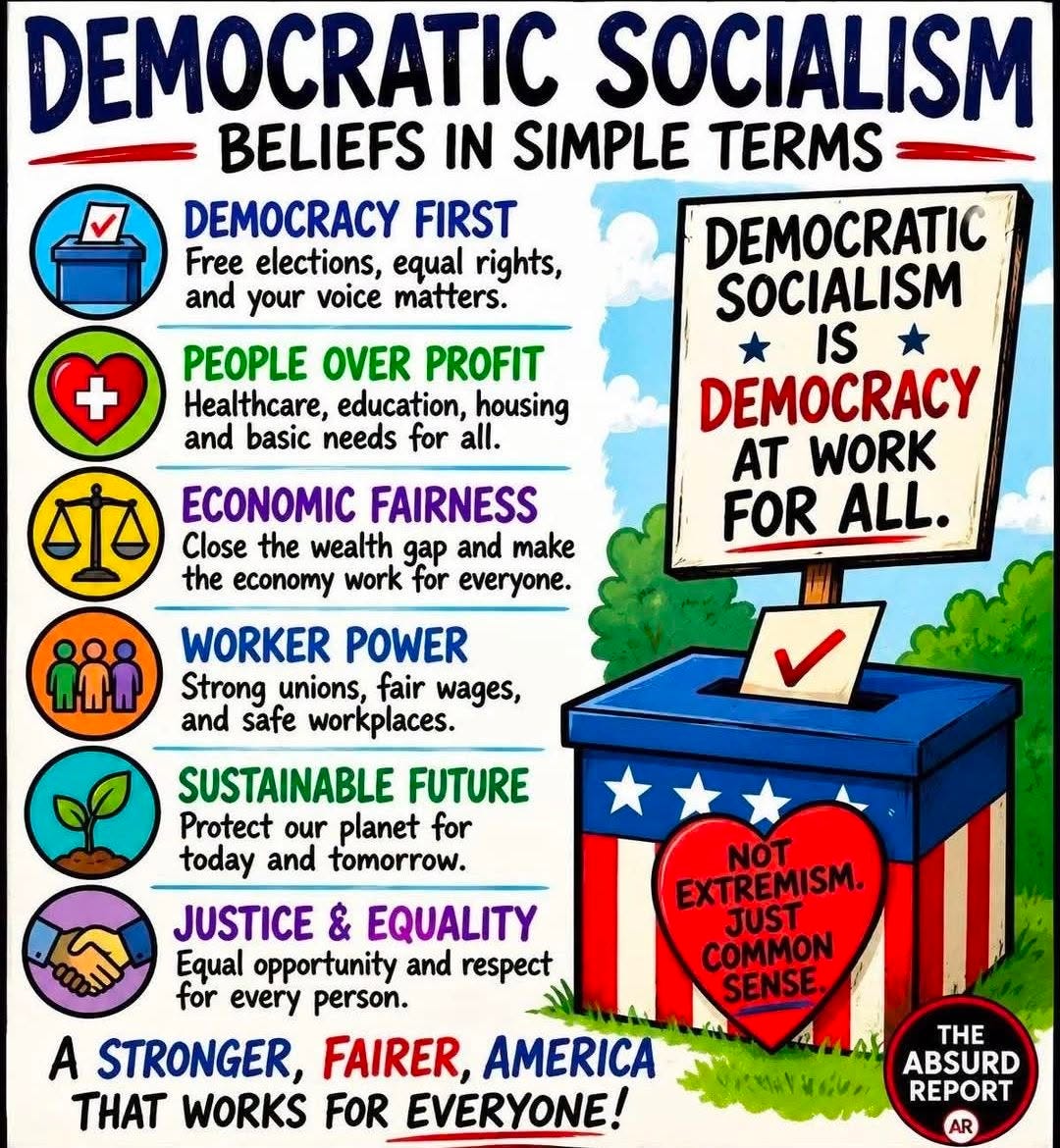
- Scott presents a second, more accessible graphic: democracy first, people over profit, economic fairness, worker power, a sustainable future, and justice and equality — and challenges Debbie to find anything objectionable in it.
00:18:03 Debbie: Capitalism With Guardrails and Why This Isn’t Radical
- Debbie cites Heather Cox Richardson’s framing — democratic socialism as “capitalism with guardrails” — and argues the six-tenet graphic explains figures from Zohran Mamdani to Bernie and AOC. Her deeper concern: American democracy itself is currently compromised under what she calls competitive authoritarianism, with institutions actively failing, making the underlying economic-fairness conversation harder to have in isolation. She traces her own understanding back to FDR and the New Deal, and the decades-long oligarchic effort to unwind it.
00:21:06 The New Deal, FDR, and the Decades-Long Effort to Undo It
- Scott adds historical detail: opponents didn’t just fight the New Deal legislatively — they plotted (unsuccessfully) to assassinate FDR in the 1930s. He argues American democracy was never fully realized to begin with, running on what he calls a 1780s-era operating system into the 2020s.
00:22:13 Jesse: More Democracy in the Economy, and Why Communism Is Aspirational
- Responding to Scott’s framing of democratic socialism as “more democracy applied to the economy,” Jesse dismantles the “socialists just want free stuff” talking point, credits Marx’s enduring influence even on capitalist economists, and clarifies communism as Marx’s aspirational stateless, classless endpoint — a future Jesse says he does want, making him comfortable owning the “communist” label even while personally choosing “democratic socialist” as a pacifist uninterested in armed revolution.
00:26:00 The Vote Was Never Universal: Property, Slavery, and Who Got to Decide
- Jesse argues America has never actually operated as a functioning democracy for its full population — for most of its history, voting required either unwritten ideological conformity or property ownership, precisely because put to an actual vote, things like slavery or letting a billionaire have a third house before children are fed wouldn’t survive. He contends most people are functionally socialist without knowing the term, having simply forgotten the kindergarten-level ethics of sharing and mutual care that the wealthiest routinely violate.
00:28:39 Blythe on Faith: The WWJD Bracelet and the Devil Label
- Scott connects Jesse’s kindergarten-ethics point to Jesus’s teachings about caring for the vulnerable, noting Blythe made the same connection in the chat. Asked directly what democratic socialism means to her, Blythe answers: not what currently exists. She argues the Democratic Party platform is already quietly socialist but undermined by corporate ties, and describes the whiplash of growing up wearing WWJD bracelets only to be branded “the devil” the moment you actually practice those values under a socialist label.
00:29:54 Bryce: Actually Existing Communism and the Soviet Union’s Development
- Bryce pushes back on the idea that no communist government has ever existed, invoking the framework of “actually existing communism” — the Cuban, Bolshevik, and Chinese revolutions as genuine communist projects that, by their own account, pass through a socialist developmental stage to build productive capacity and defend against counterrevolution before reaching a communist end state. He credits the Soviet Union with transforming a feudal, peasant economy into a space-faring power within a generation, and credits China with continued poverty reduction and development.
00:33:59 Most People Are Thinking About Bread and Butter, Not Chinese Development
- Bryce concedes these are highly academic conversations most Americans aren’t having — the real task for the broader left is building consensus around a popular program that moves the country toward social democracy and eventually socialism, without requiring anyone to first master Cuban balance-of-payments theory.
00:35:32 The Trump Supporter Who Wanted Free Healthcare Without the Government
- Bryce recounts a conversation with a college Trump supporter who opposed Medicare for All on principle but, pressed further, described a preferred alternative — redirecting government healthcare money to nonprofit providers offering free care — that Bryce points out is actually more radical than Medicare for All, illustrating how deep the ideological aversion to naming things runs even when the underlying policy preference is nearly identical.
00:37:09 Debbie: ‘Sell the Brownie, Not the Recipe’
- Debbie introduces messaging strategist Anat Shenker-Osorio’s mantra — “sell the brownie, not the recipe” — arguing successful messaging (citing Mamdani’s rent control, grocery store, and free bus platform) leads with concrete deliverables rather than ideological labels, while cautioning that this isn’t about running from the labels so much as not leading with them.
00:41:49 Owning the Label: Truman’s 1952 Quote on What They Call Socialism
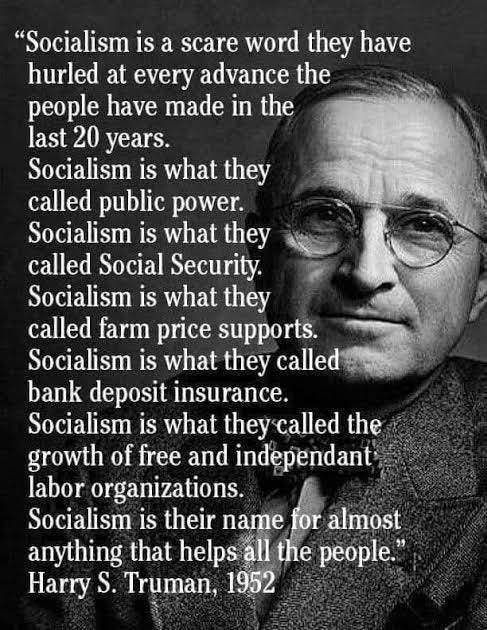
- Scott reads a 1952 Harry Truman quote listing public power, Social Security, farm price supports, bank deposit insurance, and labor organizing as things that were all smeared as “socialism” in their day — arguing the smear has always attached to anything that broadly helps people, regardless of what it’s actually called.
00:42:51 Jesse: Thomas Horrocks, Hammer and Hoe, and Why the Labels Follow You Anyway
- Jesse cites local candidate Thomas Horrocks — a National Guardsman and pastor who never called himself a socialist — still getting hit with hammer-and-sickle attack mailers, proof that avoiding the label doesn’t grant immunity from the attack. He recommends the book Hammer and Hoe on Alabama’s Communist Party organizing against segregation in the 1910s–1950s, and situates Eugene V. Debs’s imprisonment as punishment for opposing World War I, not for his socialism per se. His conclusion: solidarity with people to the left who use labels you’re not personally comfortable with matters more than distancing yourself from historical authoritarian excesses, especially when masked secret police are currently active in American cities. He also describes his own approach as an elected official — being transparent about “crazy left-wing ideas” while pointing out that colleagues who take corporate money don’t vote their constituents’ actual preferences.
00:48:36 Blythe’s Last Word, and Scott’s Question About Make America Great Again
- Blythe confirms she can keep listening while stepping away momentarily. Scott, noting she grew up in and lives in a conservative part of the state, asks what “Make America Great Again” nostalgia for the postwar 1950s actually depends on — high union density, a 90%-plus top marginal tax rate, and massive government investment via the New Deal — daring MAGA supporters to actually endorse those specifics. This is Blythe’s final appearance before departing the conversation early.
00:51:02 Branding as the Whole Game: The Kid for Trump Who’s Basically a Socialist
- Scott and Bryce agree the whole dynamic is branding and team loyalty divorced from substance. Bryce revisits his Trump-supporting student conversation: the same person favored healthcare access and opposed foreign wars and medical debt, yet stayed loyal to “Team Trump” regardless. Bryce argues most consequential economic decisions (Federal Reserve policy, full employment definitions) are entirely outside public debate, which instead gets reduced to culture-war distractions with no bearing on actual distribution and production questions.
00:55:05 The DSA Platform: Three Categories and What the Right Fixates On
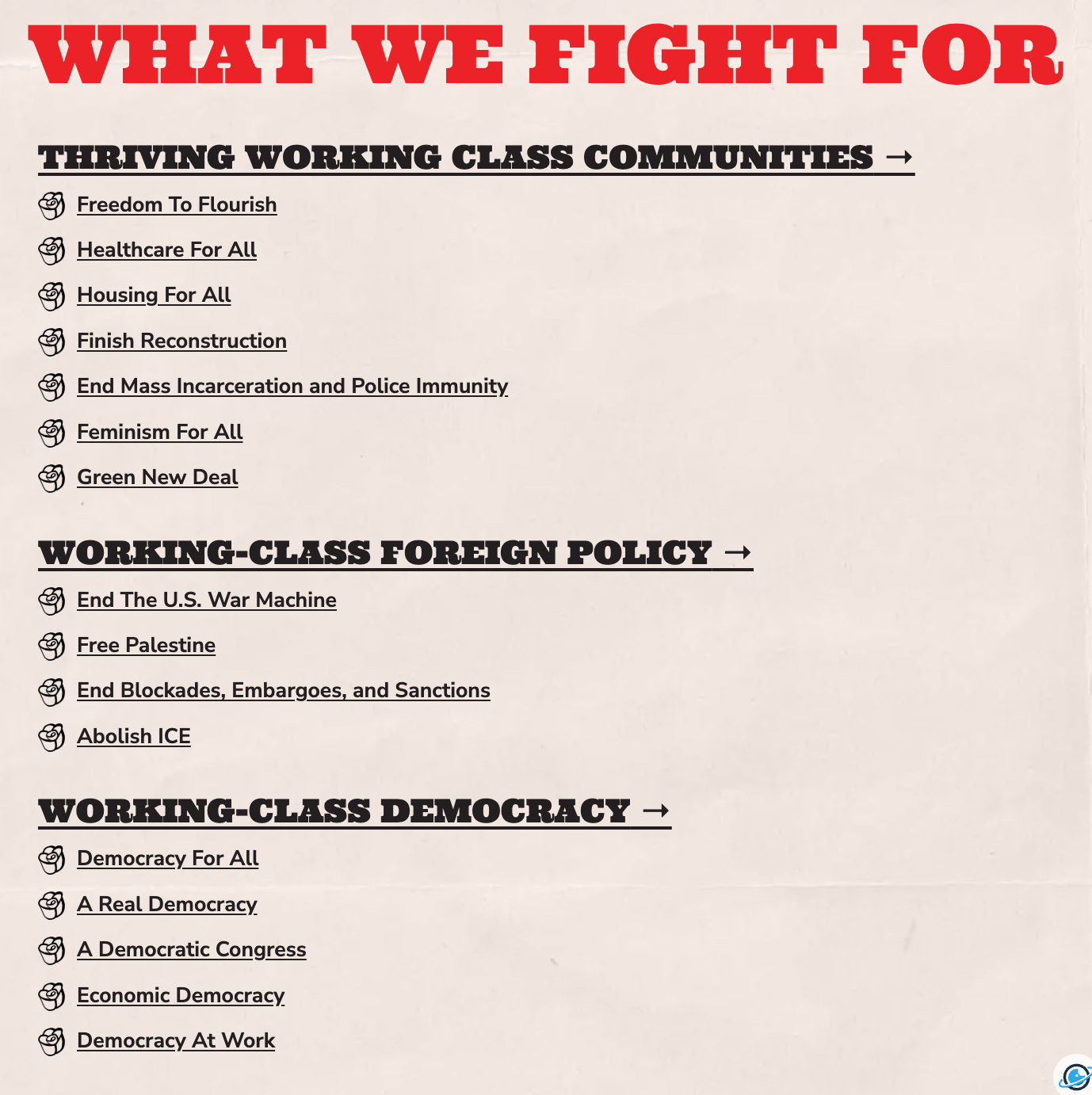
- Scott introduces the national DSA platform’s three pillars — thriving working-class communities, working-class foreign policy, and working-class democracy — and notes the right reliably fixates on “abolish the police” and “abolish prisons” as aspirational long-term goals, not immediate proposals.
00:56:41 Debbie: Defund the Police as a Framing Failure
- Debbie traces “defund the police” back to the George Floyd era: a framing that was catastrophic for the politicians who adopted it, requiring endless after-the-fact clarification, when the actual underlying ask (redirect some funding to mental health response) tests well. She distinguishes this from her own current position — she says “abolish ICE” outright at protests, arguing that agency is beyond reform.
00:59:04 Abolish ICE, the Midterms, and What Low-Propensity Voters Actually Hear
- Debbie cites Sarah Longwell and Anat Shenker-Osorio’s focus group research: most voters don’t start paying attention until after Labor Day, aren’t “low-information” so much as busy, and respond to concrete promises about making life more affordable and manageable — not label debates. Her advice: don’t run from the labels, but don’t lead with them either, and keep hammering the urgency of this specific midterm.
01:01:23 Means vs. Ends: Debbie on Not Confusing the How With the Why
- Debbie draws a distinction between the “how” (open to genuine debate) and the “end” (an equitable economic system, a democracy that works for people) — arguing the movement needs to keep its eyes on the end goal while allowing real debate over mechanisms, and get enough aligned people elected to have that mechanism debate productively.
01:02:21 Walking Through the DSA Platform Line by Line
- Scott reads through specific DSA platform planks — paid family leave, a 32-hour workweek with full pay, free public education pre-K through college, universal healthcare, housing for all — arguing almost none of it is genuinely objectionable to most Americans regardless of party.
01:05:03 Finishing Reconstruction, Palestine, and a Generational Shift on the Right
- Scott highlights the platform’s call to finish Reconstruction, addressing generational racism the country never fully confronted after the Civil War — a position he says only the “handful of crazy people” who gathered in Indiana for a recent “mass deportation rally” would object to. He notes rising cross-partisan sympathy for Palestinians, especially among Republicans under 50, and frustration on the right that Trump hasn’t actually ended the forever wars he promised to end.
01:09:05 Abolish the Senate? Admitting New States and the 1780s Operating System
- Scott addresses one of the platform’s most-attacked planks — Senate abolition — conceding it’s constitutionally unrealistic in the near term, but argues for achievable structural fixes like admitting new states to correct the Senate’s dramatic rural overrepresentation (roughly 20% of the population currently holding effective veto power).
01:11:03 Bryce: This Isn’t Radical, It’s Just What People Already Believe
- Bryce agrees none of this is genuinely radical — people already believe in housing, healthcare, and functioning democratic institutions; it’s propaganda and distraction that manufacture opposition. He locates himself as a centrist within DSA’s internal spectrum — between a faction that wants to simply become better Democrats and one that rejects electoralism entirely — arguing engagement with existing Democratic institutions is necessary, since abstaining just cedes ground to figures like Hakeem Jeffries. He distinguishes this from accelerationist “heighten the contradictions” politics, which he considers a serious position analytically but not a real strategy, since it amounts to wanting things to get worse for people.
01:17:08 The Damned-If-You-Do Bind: Jamie Harrison and the Big Tent Question
- Scott names the core contradiction: former DNC Chair Jamie Harrison telling DSA-aligned candidates to go form their own party if they dislike the Democratic Party, while independent DSA candidates get blamed for splitting the left vote and electing Republicans — a bind he says amounts to “be in the tent, but shut up.”
01:18:08 Debbie: Minority Rule, the Senate, and the Case for More Parties
- Debbie connects this to structural minority rule via the Senate and gerrymandering, and argues a genuine multi-party system would better serve a country as large and diverse as the U.S. — while acknowledging she doesn’t fully understand parliamentary systems and getting there would be painful. She increasingly identifies as more independent than partisan, seeing the DSA’s role as pushing the Democratic Party toward accountability from within a two-party system that isn’t going away soon.
01:21:27 Scott: Building the System We Want Inside the Broken One We Have
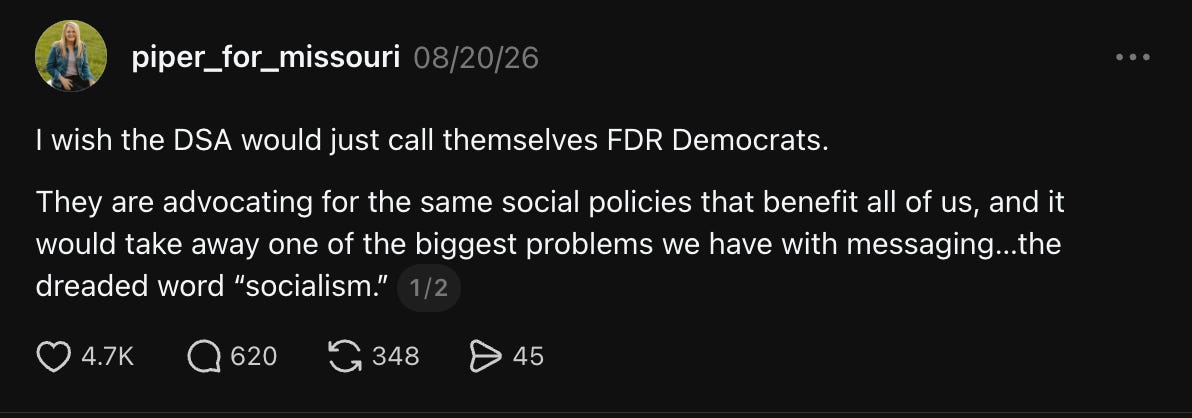
- Scott references a recent guest’s no-party-system proposal and shares a Jess Piper quote wishing DSA would simply rebrand as “FDR Democrats” to sidestep the socialism messaging problem — setting up Bryce’s response.
01:23:18 Bryce on ‘FDR Democrats’: Why the Label and the Premise Are Both Wrong
- Bryce disagrees with both the premise and the conclusion: DSA already contains an FDR-Democrat-adjacent wing pursuing CFPB-style reforms, but others hold a deeper critique — that reforms without addressing the imperial, debt-based foundation of American wealth just get rolled back later, as happened to the New Deal itself. He also argues rebranding wouldn’t help anyway — Obama, and even Trump himself, have both been called communists by their opponents regardless of actual positions, making “communist” a purely disciplinary slur rather than a descriptive term.
01:26:55 Jesse: Socialist for District 13, and Why He’ll Never Be an FDR Democrat
- Jesse describes rebranding his own campaign messaging to “socialist for District 13” specifically to avoid stepping back from the label, while noting Indiana law lets the Democratic Party remove him from the ballot entirely if it chooses. He argues FDR’s policies were reactive concessions to historic strike waves, not a genuine ceiling — and that the 1941 shift making income tax apply broadly (not just the top 5%) was driven by wartime need, not New Deal ideology. His bottom line: working people should pay far less in tax than they currently do, the ultra-wealthy are still radically undertaxed despite things like the Panama Papers demonstrating the depth of their greed, and he’s never been and will never be an FDR Democrat — while still governing pragmatically within the actual power his constituents give him.
01:32:16 Closing Words: Debbie on Authenticity as the Recipe for Voters
- Debbie praises Jesse’s model of authentic, constituent-responsive leadership as the actual recipe for winning voters across the spectrum, and expresses hope that more candidates adopting that approach can drive the structural reformation the country needs.
01:33:37 Closing Words: Bryce on Building Institutions Beyond the Ballot Box
- Bryce stresses that socialism isn’t just electoral politics — if voting is where your political engagement begins and ends, you’ve already ceded ground. He calls building durable left institutions (comparable in persistence, if not funding, to something like AIPAC) the defining project of this generation, on the road toward what he only half-jokingly calls fully automated luxury gay space communism.
01:35:30 Closing Words: Jesse on Mutual Aid, Organizing, and What You Can Do Right Now
- Jesse distinguishes charity (handing out aid to people you’ll never see again) from mutual aid (building durable trust and solidarity you can mobilize later), and gives concrete starting points: organize your apartment building, unionize your workplace, start or strengthen a tenants’ or neighborhood association. He offers to personally train anyone interested in challenging incumbents next cycle, while stressing electoral politics alone isn’t the whole project — talking to your actual neighbors is where it starts.
01:38:37 Closing and Sign-Off
- Scott thanks Debbie Asberry, Jesse Brown, Bryce Greene, and Blythe Potter (who had logged off earlier), previews Sunday’s HoosLeft This Week guests — Statehouse District 13 candidate Ben Davis and Washington County Democrats secretary Renee Mather.


